

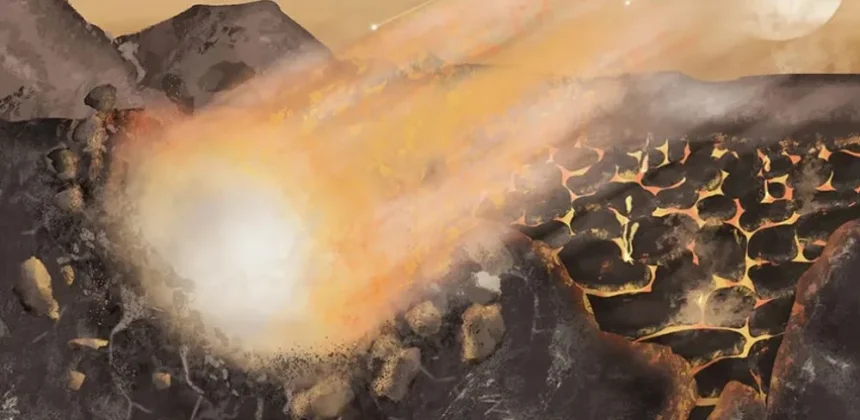
The appearance of life on Earth is still a mystery. It’s constrained by a few factors; for instance, the Earth had to have cooled before life could get started, and there had to be some liquid water, the right chemicals, and an energy source. But most of the details are hidden in the deep past.
As science has progressed and our observing power has advanced, some pieces of evidence have emerged that carry tantalizing hints at the bigger picture of life appearing on Earth. Scientists have found that comets carry important organic compounds. That has led to the hypothesis that comets could have seeded Earth with chemistry that led to abiogenesis. These include the amino acid glycine, phosphorous, and hydrogen cyanide (HCN), a chemical compound of particular importance.
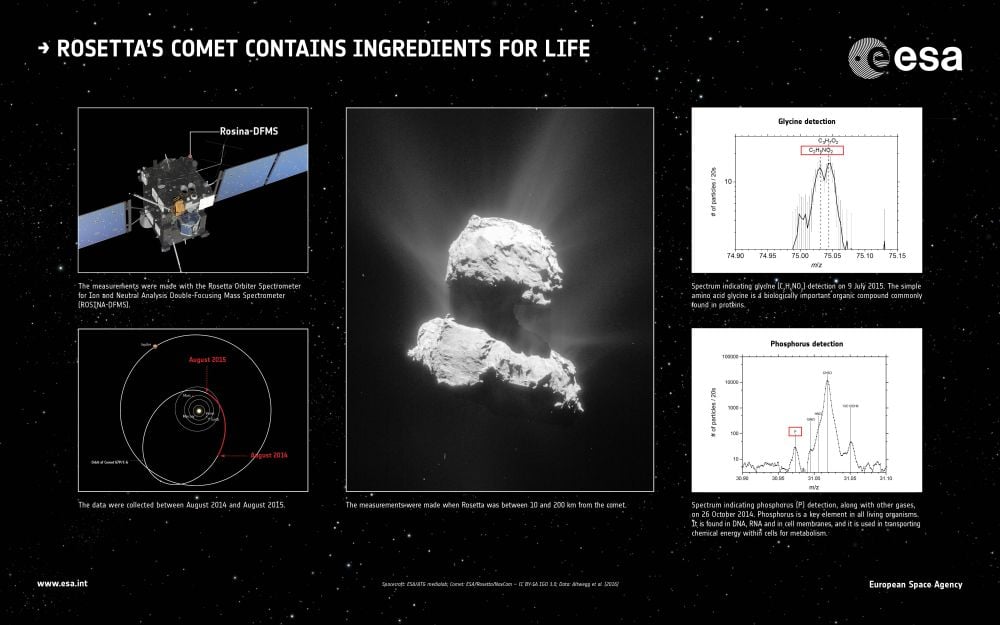 The ESA’s Rosetta mission, which included the Philae Lander, visited the comet 67P/Churyumov–Gerasimenko in 2014 and detected glycine, an amino acid, and phosphorous, an organic chemical. Phosphorous is an important element in all living things, and is a critical part of DNA and RNA. These findings helped generate the idea that comets played a role in seeding the early Earth with the chemistry necessary for life. Image Credit: Spacecraft: ESA/ATG medialab; Comet: ESA/Rosetta/NavCam – CC BY-SA IGO 3.0; data: Altwegg et al. (2016). LICENCE: ESA Standard Licence
This hypothesis is not widely-accepted, but hasn’t been conclusively disproven, either. We’re in the early stages. But new research shows that it is unlikely that comets seeded Earth with the chemistry that led to life.
The research is titled “Cometary impacts an unlikely pathway towards the origins of life on Earth,” and it’s published in the journal Scientific Reports. The lead author is Dr. Richard Anslow from University of Cambridge’s Institute of Astronomy.
“It’s kind of a romantic idea, but our results suggest it’s highly unlikely.” – Dr. Richard Anslow, Institute of Astronomy, University of Cambridge.
“An early period of cometary bombardment has long been speculated to provide an important source of prebiotic feedstock molecules, required for the origins of life on Earth,” the authors write. “In support of this interpretation, comets boast a rich diversity of volatile organic molecules, with many thought to be limiting for prebiotic chemistry.”
“The origin of life on Earth presumably resulted from prebiotic chemistry, the synthesis of key molecular building blocks from an initial reservoir of reactive bioessential feedstock molecules,” they continue. “Hydrogen cyanide (HCN) has emerged as a key feedstock molecule…” they state. HCN can drive high-energy reactions central to prebiotic synthesis.
But just because comets carry these molecules, and just because comets crashed into Earth, it doesn’t follow that they were able to deliver organic molecules intact. Comet impacts are very energetic events that generate high temperatures. “Modelling studies suggest, however, that a significant proportion of these molecules will be destroyed during hypervelocity impact,” the researchers write.
The researchers worked with simulations of comet impacts, discoveries about how comets interact with atmospheres, and dynamic modelling showing where short-period comets originate and how they evolve. They focused on HCN, since it plays such a critical role. The results do not support the cometary delivery idea.
The researchers say that the cometary bombardment didn’t last long enough, and also that if any molecules did survive, there weren’t enough of them.
“Taken together, the rapid decline in Earth’s cometary impact bombardment and the efficient destruction of fragile cometary organics indicate that the successful delivery of prebiotic feedstock molecules was an exceedingly rare event,” the authors write.
“Historically, scientists thought that comets were important for the origin of life on Earth, because they carried carbon- and nitrogen-bearing molecules, so these giant space snowballs were almost like a ‘get out of jail free card’ that brought all the molecules a planet would need to seed life,” said lead author Anslow . “It’s kind of a romantic idea, but our results suggest it’s highly unlikely.”
The destruction of organic compounds in the impacts themselves the authors left to previous researchers. Previous work shows that the survivability of HCN has been overestimated. For example, a 2020 paper points out that only “the most favorable impacts (low impact angle, low velocity, small radius)” would not breach the temperature threshold that destroys HCN. Were there enough of those?
In this work the researchers focused on short-period comets. Not because long-period comets don’t also carry the chemicals in question, but because short-period comets have substantially lower velocities, increasing the odds of the chemical surviving the impacts with Earth.
Their analysis showed that size matters. Smaller comets are likely to be torn apart as they enter the inner Solar System. The torque generated by their off-gassing introduces rotational istability that tears many of them apart. That reduces the overall number of comets that struck the ancient Earth.
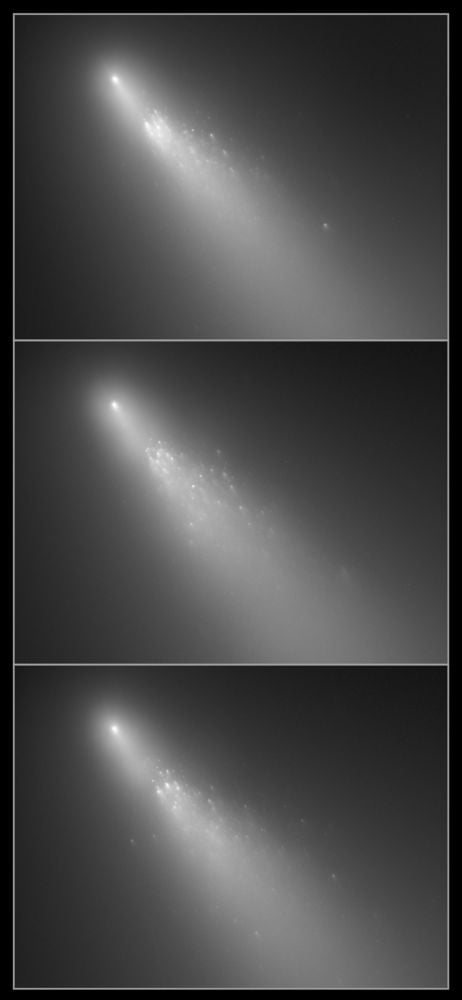 Comets can break apart in spectacular displays as they approach the Sun, as shown in these Hubble images of Comet 73P/Schwassmann-Wachmann 3. Tidal forces can rip them apart, rapid rotation can destroy their nuclei, out-gassing can destroy them with eruptions, and thermal stresses can also cause their demise. Image Credit: NASA, ESA, H. Weaver (APL/JHU), M. Mutchler and Z. Levay (STScI). LICENCE: ESA Standard Licence
They also point out that many of the comets would’ve been destroyed after entering Earth’s atmosphere, and never even reached the planet’s surface. “The low density (i.e., high porosity) and weak mechanical strength of comets combine such that comets are particularly vulnerable to destruction during atmospheric passage,” the authors explain. “Earth’s atmosphere therefore acts as a filter—preferentially destroying small and oblique comets—and thus, biasing the population of comets able to deliver prebiotic feedstock molecules to local surficial environments.”
The cometary bombardment of Earth slowed to a crawl after about the first 500 million years of the planet’s history, reflective of the fewer number of bodies travelling around in the chaotic young Solar System. Overall, this work shows that there were most likely only a handful of comets that could have delivered any HCN to Earth.
“On a global scale we find, in agreement with the results of Todd & Öberg, that comets are unable to deliver a prebiotically relevant concentration of HCN to the early Earth,” the authors write. It takes more than a small amount of HCN to be relevant.
One idea says that comets not only delivered the critical HCN, but that the impacts created subterranean hydrothermal systems that could have brought HCN into an environment already conducive to abiogenesis.
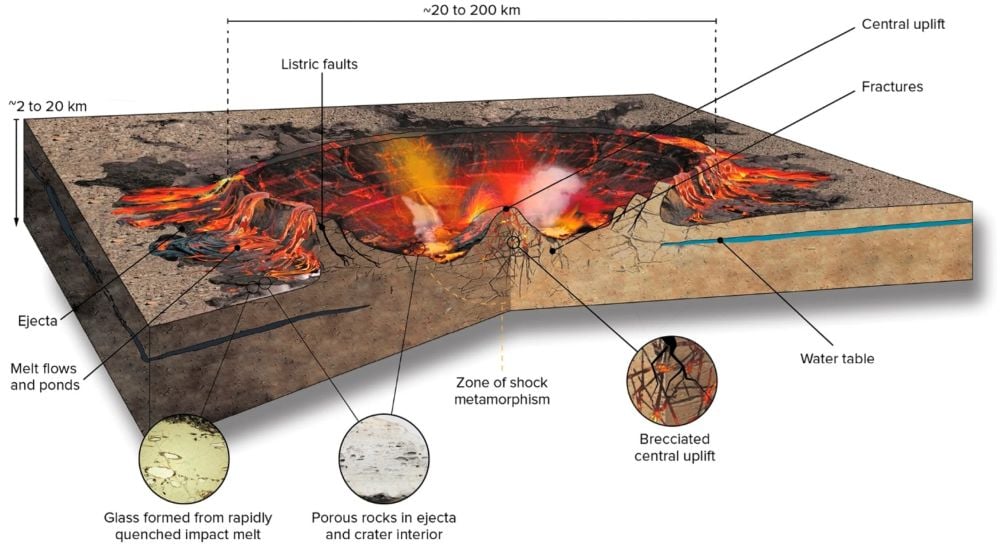 This graphic shows how impacts can generate a hydrothermal system with conditions conducive to the appearance of life. If cometary HCN was delivered in sufficient quantities, it may have played a role in life appearing in these environments. Image Credit: Journal of Marine Science and Engineering (2026). DOI: 10.3390/jmse14050486
But Anslow and his co-researchers also discount that based on the rapid flow of water into the environment. “A salient outcome of high-velocity cometary impacts, irrespective of the delivery of HCN, is thus the rapid influx of local groundwater into the newly-formed crater-lake, rapidly diluting surviving cometary HCN below prebiotically relevant concentrations,” they write.
So it doesn’t look good for the cometary-delivery hypothesis.
“It would really have to be a one-in-a-million occurrence, because not only would you need an impact at just the right speed and just the right angle, you would also need everything to happen after that point, in terms of the concentration and the speed at which the chemical origins of life got going,” Anslow said in a press release. “We can’t rule out for certain that it happened that way. But it seems to be a really rare occurrence – at best, a one-off fluke.”
The researchers also examined if the same limitation for cometary delivery were true for Mars, which may have hosted life in the distant past.
“We find that cometary delivery is far more effective onto Mars,” the authors write, despite a smaller number of impacts. “This efficiency is driven primarily by lower cometary impact velocities—a consequence of Mars’ lower escape velocity and larger semi-major axis—and Mars’ tenuous atmosphere,” they explain. More smaller comets would survive compared to Earth, meaning a larger delivery of HCN. In fact, the rate of surviving comets at Mars is five times higher than for Earth.
“This simple comparison between the Solar System’s terrestrial planets suggests that, all else being equal, Mars would have been the more favourable target for the cometary delivery of prebiotic feedstock molecules, and if cometary delivery is an important prerequisite step for prebiotic chemistry, strengthens the possibility that life could have emerged on Mars,” the authors write. But they caution that this is a best case scenario, and there are a host of other considerations that weaken the idea.
“This is not to say it definitely happened on Mars, of course, but suggests it would be unlikely if it happened on Earth and didn’t happen on Mars,” Anslow said. “Or the other, perhaps more likely, alternative, is that it didn’t happen on either planet.”
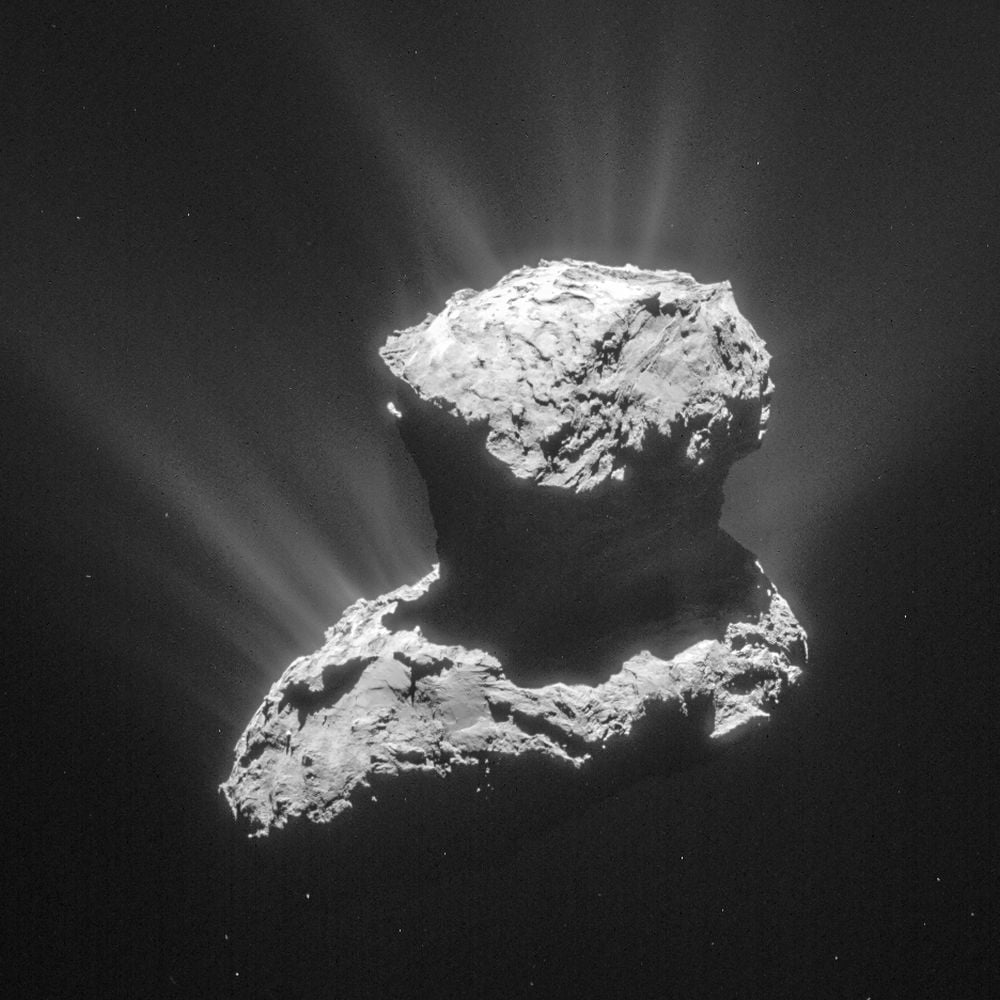 This is comet 67P/Churyumov–Gerasimenko, visited by the ESA’s Rosetta mission and its Philae lander in 2015. It was taken from a distance of 86.6 km, only a few days before a much closer flyby. The Philae lander’s COSAC and Ptolemy instruments detected sixteen organics on the comet’s surface, including HCN and the amino acid glycine. Unfortunately, it’s a big leap from finding these chemicals on a comet and them being delivered to Earth in enough quantities to contribute to the appearance of life. Image Credit: ESA/Rosetta/NavCam – CC BY-SA IGO 3.0. LICENCE: ESA Standard Licence
There’s no question that comets carry important organics in high enough concentrations to matter, but the successful delivery to Earth, at the right time, in the right concentrations, and in the right locations, is far more complicated. Many factors contribute to the unsuccessful delivery of cometary HCN to Earth.
“Although Solar System comets boast a rich diversity of volatile organic species—including crucially many prebiotic feedstock molecules in high concentration—we have shown via Monte Carlo simulation of Earth’s cometary bombardment that these comets were, on the whole, unable to deliver these fragile organic molecules to Earth’s surface intact,” the researchers write.
So the mystery of how life started on Earth endures, and despite finding important chemicals like HCN on comets, and despite the tantalizing idea that they could have delivered it to Earth, detailed modelling shows how unlikely that was.
“To summarise, our results demonstrate that Earth’s cometary bombardment was unable to provide the concentrated reservoir of bioessential feedstock molecules required for synthetic prebiotic chemistry, challenging the long-held suggestion that cometary impacts may plausibly have played an important role in the origins of life on Earth,” the researchers conclude.